
Component sourcing
How to Order TPS2490DGSR for a 500-Board Build
One assembler asks for 510 devices for a 500-board run. Follow three quotes from feeder requirements and delivered cost through the receiving check.
On this page
The supplier’s email says, “TPS2490DGSR, 500 pcs, cut tape, ships Thursday.” Purchasing has found the right controller. Across the hall, the assembly planner has booked Monday morning for 500 boards. Can purchasing release the order?
Ask the assembler two questions before you sign. How many loaded parts does it need, and what can it put straight onto the line? You can request 500 TPS2490DGSR devices on a custom reel if the supplier can prepare one. A quote for cut tape alone leaves open how many strips will arrive. And a build of 500 boards may call for more than 500 parts.
Here is a worked example. The quantities on TI’s standard packs come from its ordering pages. The assembly instructions, supplier offers, costs and dates below are illustrative so you can substitute your own figures.
What would the assembly line accept on Friday?
The planner comes back with four details. Each board takes one controller. The assembler wants ten extra devices for setup and possible replacements. Its booked feeder takes one uninterrupted strip on a reel with empty tape at both ends. Receiving must have the kit by Friday at noon, plant local time. The carrier can deliver on Friday afternoon and still miss this build.
That turns “500 pcs, ships Thursday” into a different buying instruction. Quote 510 loaded devices, ask for the leader and trailer lengths on the assembler’s feeder sheet, and work backwards from the receiving cutoff. Those lengths tell the supplier how much empty tape to provide. Empty pockets do not count toward the 510 devices.
Which part number belongs on the quote?
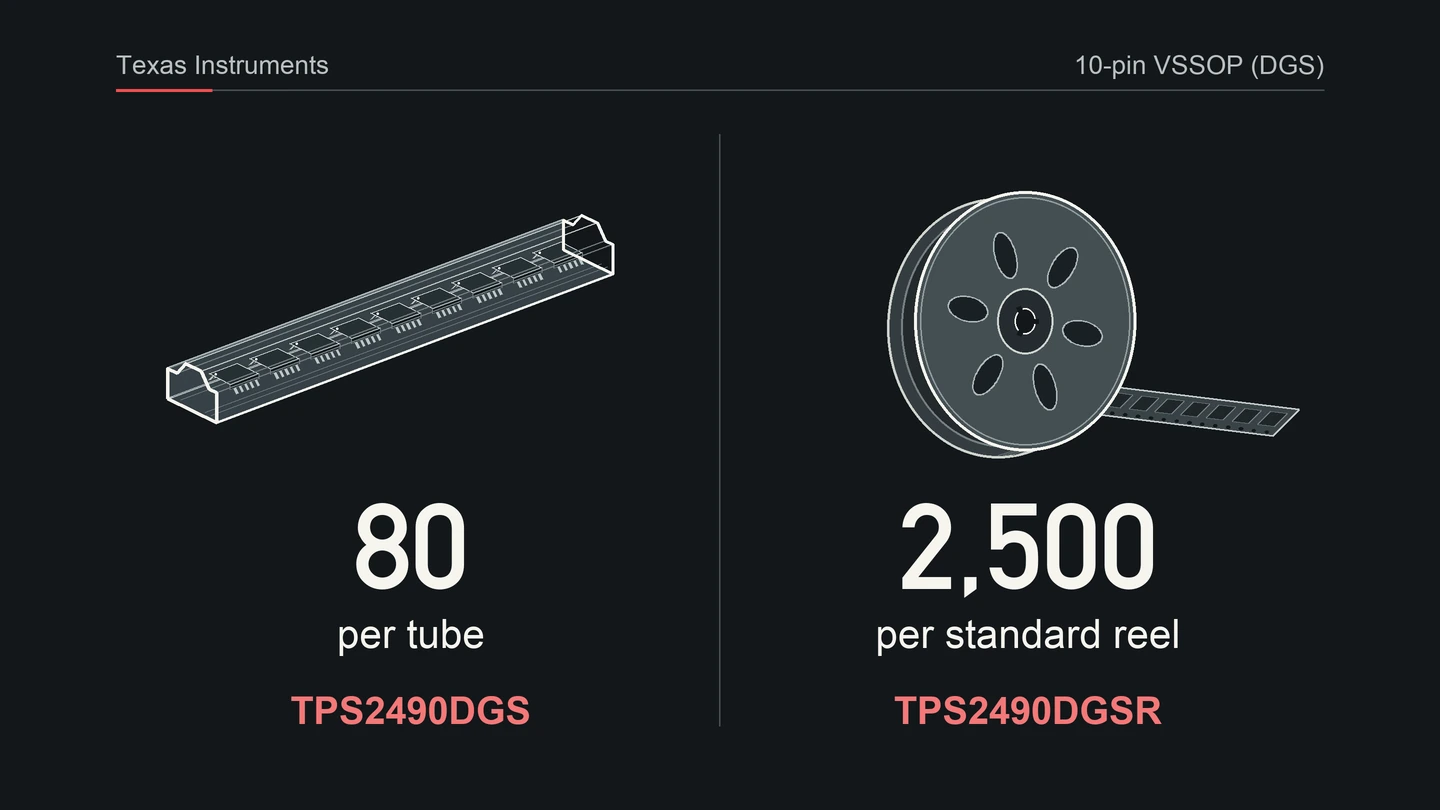
Texas Instruments lists TPS2490DGSR as a 10-pin VSSOP controller supplied on a standard reel of 2,500. TPS2490DGS is the same device supplied in tubes of 80. The R matters to purchasing. A distributor can cut pieces from a DGSR reel and still accurately list the DGSR part number. The part number alone cannot tell receiving whether the order contains one reel or three loose strips. TI reel ordering details and TI tube ordering details.
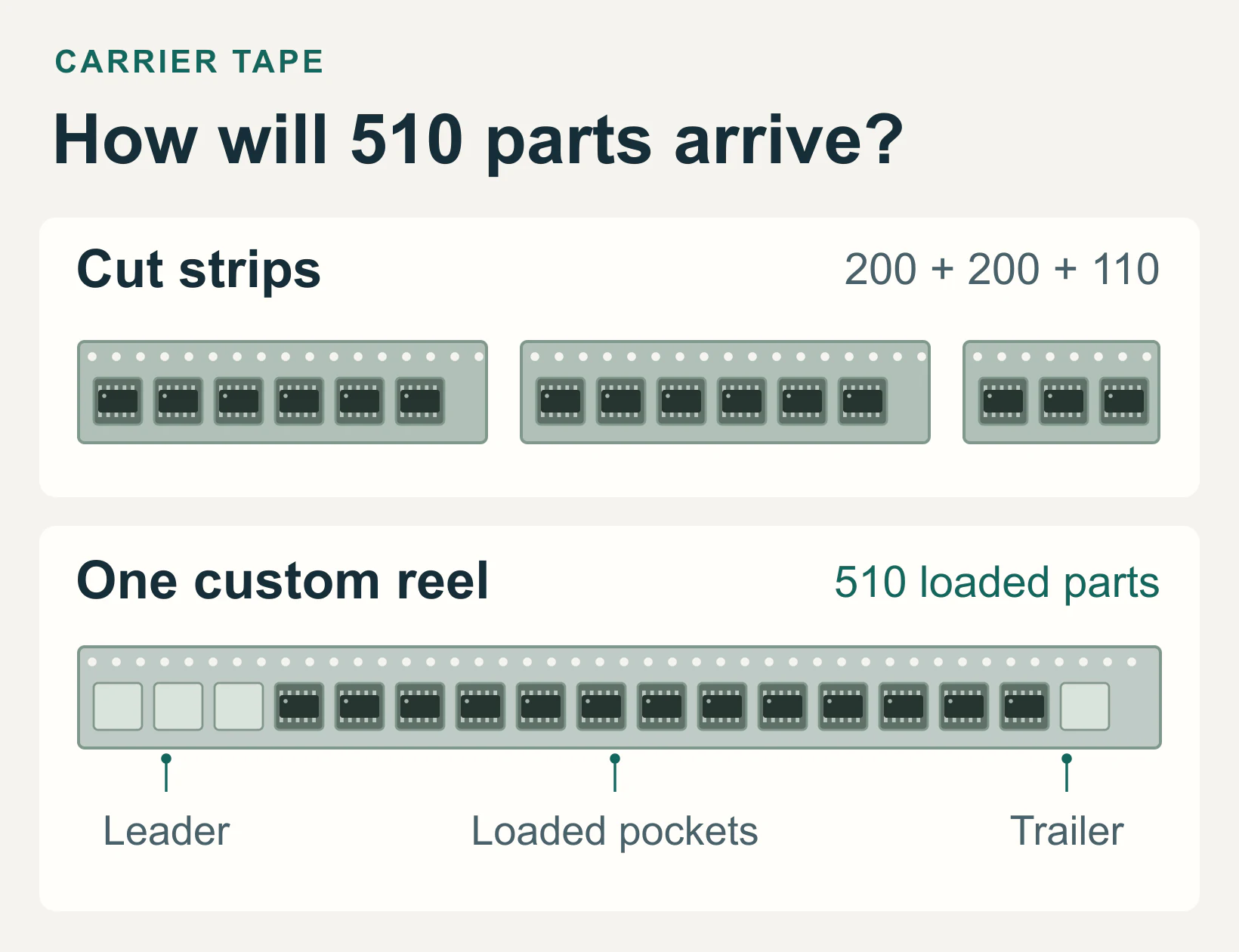
TI describes its custom reel as an exact quantity taken in one continuous length from a source reel, with empty tape added at both ends. TI also explains that a cut-tape order can arrive in multiple strips. Ask other suppliers how they prepare their reels. If the purchase specification calls for an unopened manufacturer reel, have quality decide whether it can accept a traceable custom reel before promising one to production. TI’s carrier packaging guide.
Which of three offers covers the booked run?
The buyer asks for pricing in US dollars with delivery to the same plant. In this example each offer includes $24 freight. The assembly fee for placing the components is common to all three and is omitted. Only extra work specific to a packing choice is counted.
Offer A — cut tape or one custom reel
The supplier has 510 cut pieces at $1.80 each. With freight, that is 510 × $1.80 + $24 = $942. Asked about continuity, the supplier checks its stock and reports three strips of 200, 200 and 110. All 510 are accounted for. This packing cannot run on the booked feeder under the assembler’s instructions.
The supplier also has an uncut source reel. It offers to take one continuous run of 510 from that reel and add the specified leader and trailer for $22. It confirms arrival at 10 a.m. Friday. The revised total is $964. Winding the original three strips onto a reel would leave two breaks between loaded sections. Ask the supplier to put the uninterrupted run and arrival time on the revised quote.
Offer B — seven tubes and a transfer
A second supplier offers TPS2490DGS at $1.55 each in full tubes. Six tubes supply 480, so the buyer needs seven. 560 × $1.55 + $24 = $892 delivered. The transfer service quotes another $80 to prepare 510 on a reel, leaving 50 in tube stock. That brings the total to $972, and the earliest the service can have the reel ready is Monday afternoon. The buyer rules it out for the morning slot.
Tubes could win on another build. If the assembler can feed them directly and the approved parts list permits DGS, they cost $72 less here than the $964 custom reel. That $72 is the most you can spend on extra handling before the price advantage disappears. Get approval for the changed orderable part number if the parts list specifies DGSR.
Offer C — the full TI reel
A third supplier can deliver a sealed standard reel by Friday morning at $1.40 per device. 2,500 × $1.40 + $24 = $3,524. It meets the feeder requirement, but committing to it takes $2,560 more cash now than the custom reel. Once 510 devices are allocated to this build, 1,990 remain.
What if sales expects five runs of 500 boards? At 510 devices allocated per run, five runs require 2,550. One standard reel would still leave the fifth kit short by 50 on that planning basis. Count firm build releases and check what each kit actually needs before committing the balance to future orders.
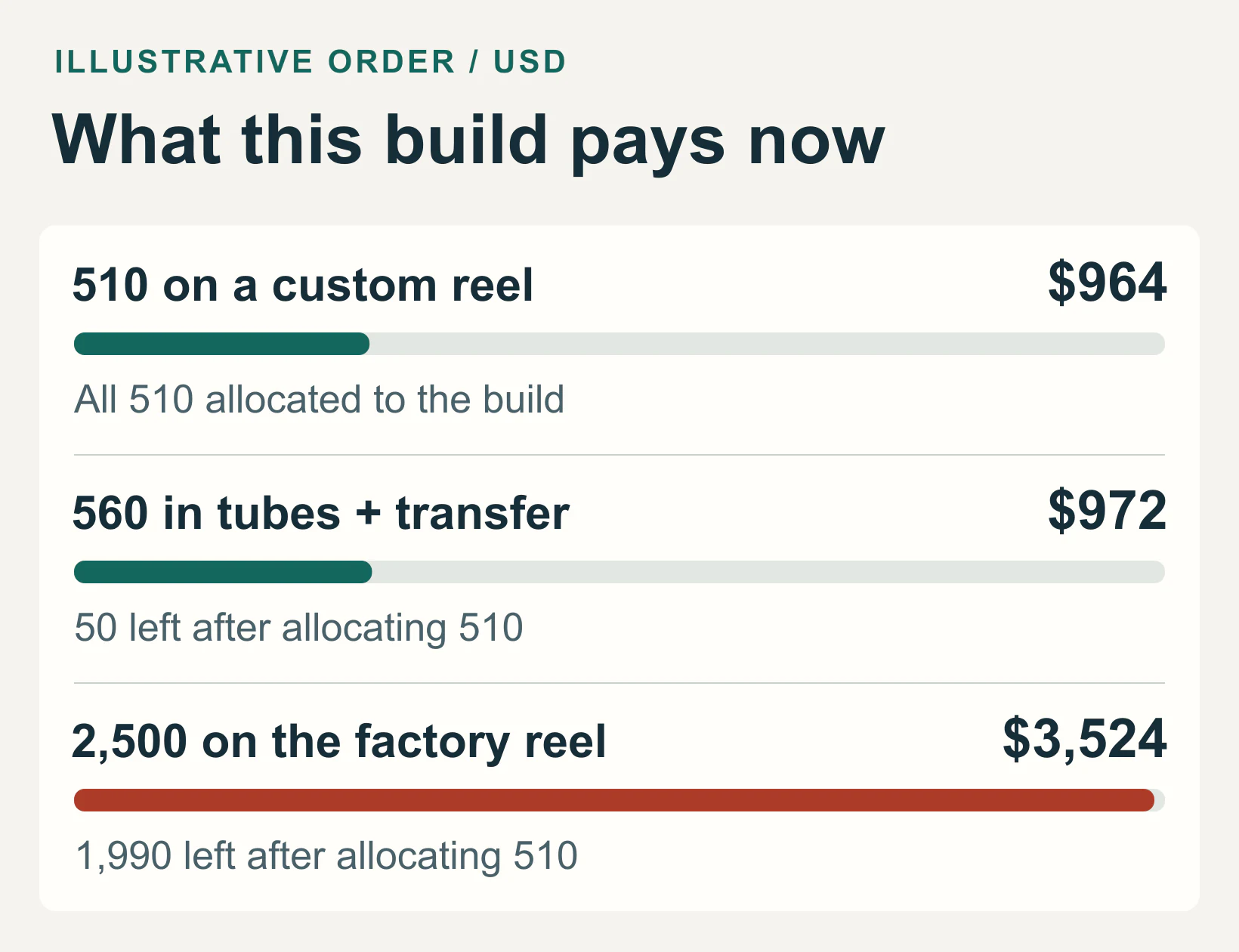
The buyer selects Offer A’s custom reel, subject to written confirmation of the packing and Friday arrival. If the plant instead requires the original seal, Offer C is the only one of these three that satisfies that condition. Procurement then has a concrete approval request for the extra $2,560 and 1,990 pieces of inventory.
What should the supplier put in writing?
Here is the reply the buyer can send. Replace the quantity, feeder requirements, receiving address and deadline with your own before using it.
“Please revise the quote to show Texas Instruments TPS2490DGSR, 510 loaded devices from one source reel, supplied in one continuous strip on one custom reel. Please use the leader and trailer lengths on our attached feeder sheet. Show the reeling fee and freight, identify the source-reel or lot record you will provide, and confirm delivery to our receiving dock by noon Friday [insert date, plant address and time zone]. Please obtain our approval before substituting multiple strips, tubes or another packing.”
Put the agreed terms on the purchase order and send them to receiving. If your quality plan requires specific markings, lot records or date codes, name the records and ask the supplier to confirm what it can provide before payment. A photo of a source reel is useful only if the shipment records connect the delivered reel to it.
What if the box arrives with the right part and quantity?
Imagine the packing list arrives marked “TPS2490DGSR, 510 pcs.” A second line reads “strip quantities 200 / 200 / 110.” The receiver now has enough information to put the material on hold before it reaches the operator. It would have passed a part-number-and-quantity check.
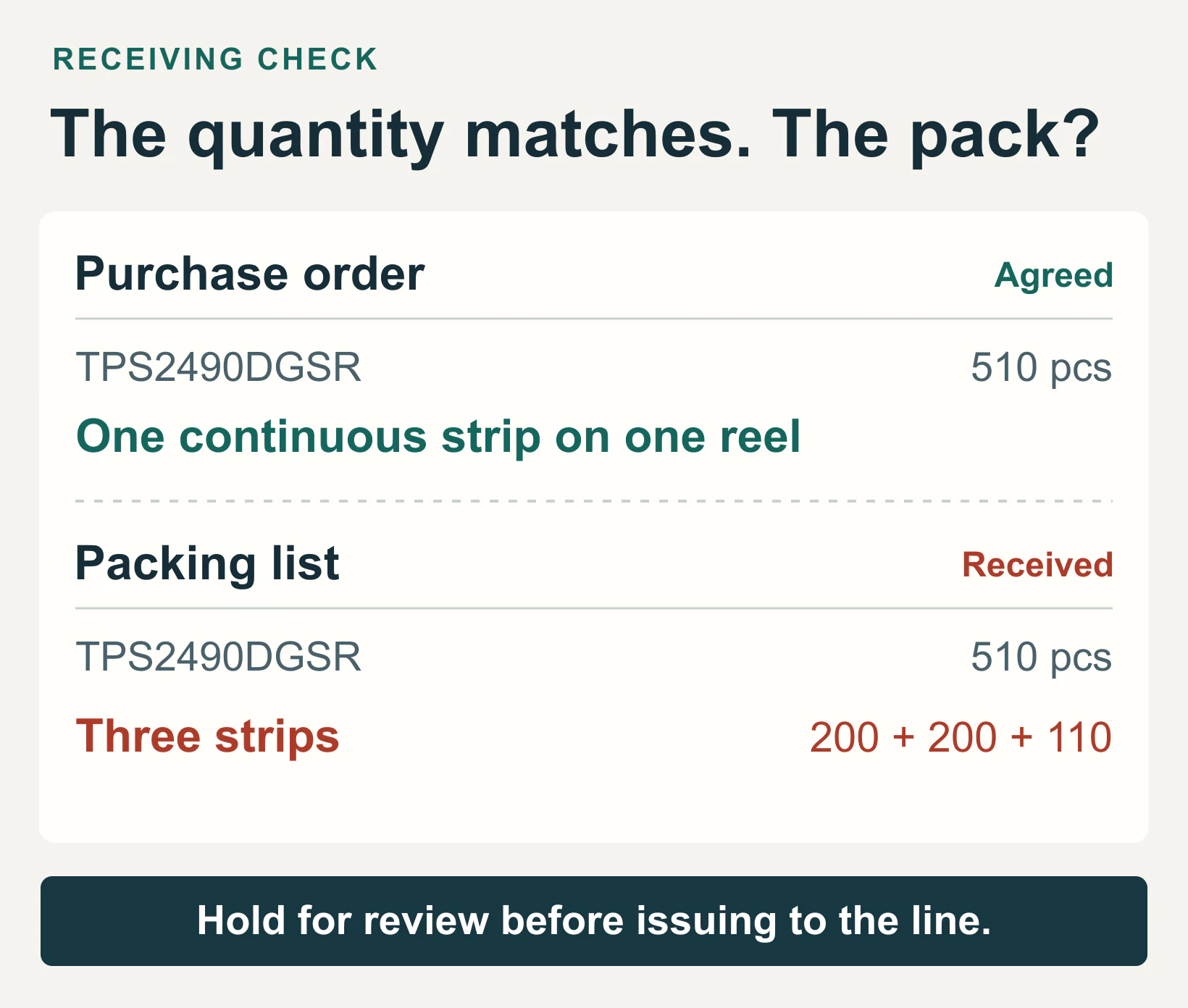
Match the delivery label and packing list to the PO, record the delivered reel ID and the agreed source reference, and photograph any discrepancy without breaking protective packaging. Then give purchasing and the assembler two options. Can the supplier replace it in time with the specified reel? If it cannot, can the assembler run the three strips under a written exception, and who accepts the extra setup time and cost? Keep the material on hold until the responsible people choose.
For a comparable quote, send the orderable part number, board count, loaded quantity, feeder requirement and latest receiving time. You can attach the feeder note with your TPS2490DGSR enquiry or send a BOM for quotation.